
Account
Call the API
The Checks API is at https://api.quickstatus.dev. Authenticate with a key from API Keys. Creating and revoking keys still happens in the console. This is the same data as that workspace’s console checks. It is not the homepage website checker. The same key connects an agent in Cursor, Claude Code, or Codex — see MCP.
Create a key
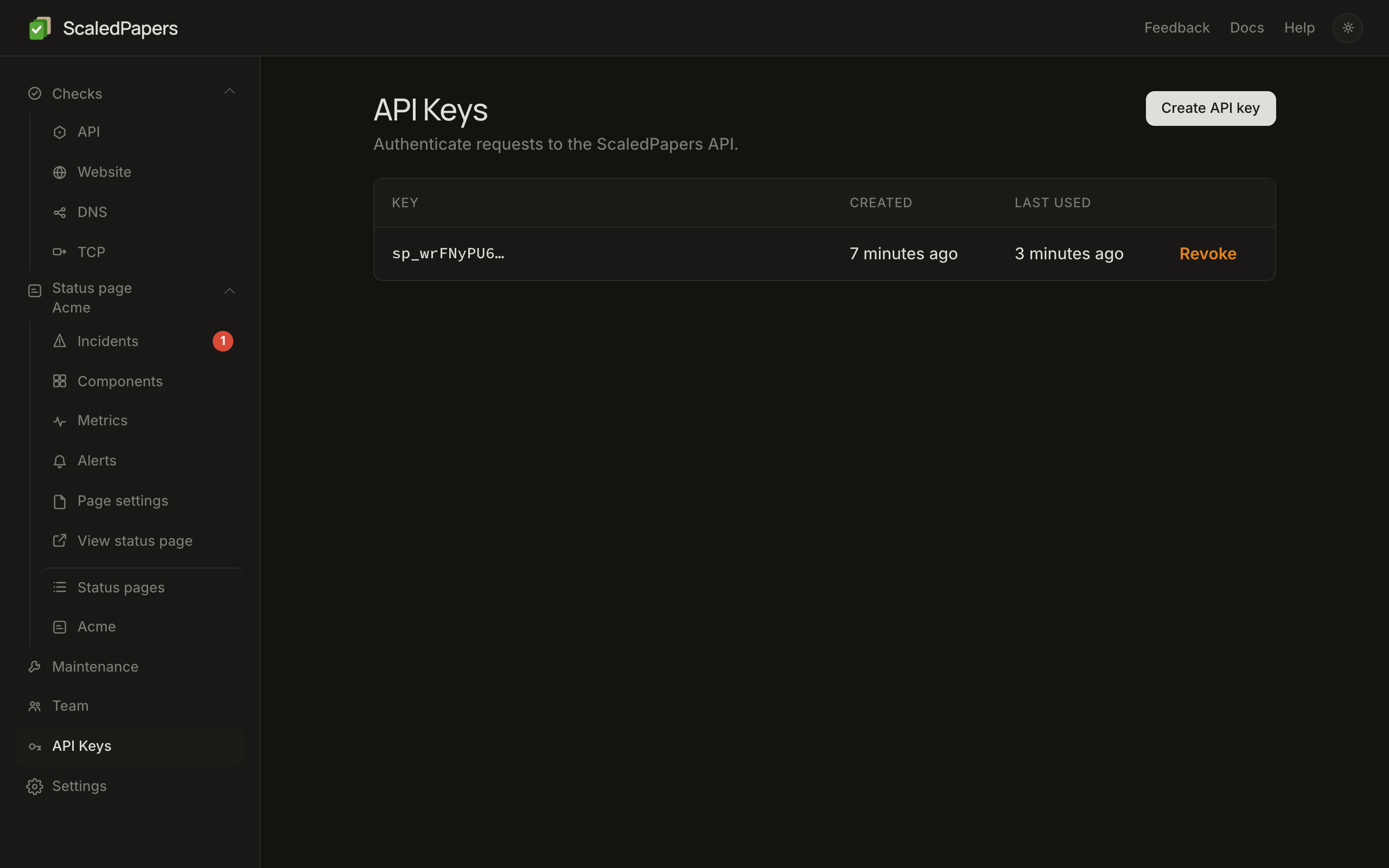
- Sign in. If you are on a team, pick the workspace in the sidebar (Personal vs the invited workspace).
- Open API Keys. Lead: Authenticate requests to the QuickStatus API. Only an owner or admin of that workspace can create a key. Members cannot.
- Click Create API key.
- Copy the secret and the sample
curl. The page says It will not be shown again.
The list then shows the key prefix (sp_…), Created, Last used, and Revoke. Revoke if a key leaks. Requests with a revoked key stop working.
The key belongs to that workspace. Calls see that workspace’s checks and status pages, not your personal workspace (unless you created the key there). Sending x-scaledpapers-workspace-id does not switch the key to another workspace. /v1/team rejects API keys.
If an admin is later changed to member, existing API keys are not revoked and keep working until an owner or admin revokes them.
Send the secret as:
Authorization: Bearer sp_…
Unauthenticated calls return JSON 401 with {"detail":"Authorization required"}.
List your checks
curl https://api.quickstatus.dev/v1/endpoints \
  -H "Authorization: Bearer sp_…"
Pipe the body to python3 -m json.tool if you want it indented. jq only works when the body is JSON.
Each check includes id, name, type (api, http, dns, or tcp), target, enabled, interval_seconds, regions (names such as us-west-1), current_status, last_observed_at, and a 40-tick recent_ticks bar for the last 24 hours.
| Console kind | type |
|---|---|
| API | "api" |
| Website | "http" |
| DNS | "dns" |
| TCP | "tcp" |
Add, change, or delete a check
Create:
curl https://api.quickstatus.dev/v1/endpoints \
  -H "Authorization: Bearer sp_…" \
  -H "Content-Type: application/json" \
  -d '{
    "name": "Production health",
    "target": "https://example.com",
    "type": "api",
    "regions": ["us-west-1"]
  }'
Useful fields for API / Website:
interval_seconds— 300 or more on the free plan (60 on Pro), at most 86400. Leave it out to use your plan's minimum.http_methodexpected_status_codesbody_containstimeout_secondsfollow_redirectsverify_sslalert_email_enabled
DNS ("type": "dns") uses a hostname as target. Extra fields: dns_record_type (A, AAAA, CNAME, TXT, MX, NS, CAA), dns_protocol (udp or tcp), optional dns_server, and optional dns_expected_values. HTTP-only fields are rejected.
curl https://api.quickstatus.dev/v1/endpoints \
  -H "Authorization: Bearer sp_…" \
  -H "Content-Type: application/json" \
  -d '{
    "name": "example.com DNS",
    "target": "example.com",
    "type": "dns",
    "dns_record_type": "A",
    "dns_protocol": "udp",
    "regions": ["us-east-1"]
  }'
TCP ("type": "tcp") uses a hostname or public IP as target. Extra fields: tcp_port (required, 1–65535), tcp_ip_family (ipv4 or ipv6), optional tcp_payload, and tcp_expected_outcome (connect or fail). HTTP and DNS fields are rejected.
curl https://api.quickstatus.dev/v1/endpoints \
  -H "Authorization: Bearer sp_…" \
  -H "Content-Type: application/json" \
  -d '{
    "name": "cloudflare.com:443",
    "target": "cloudflare.com",
    "type": "tcp",
    "tcp_port": 443,
    "tcp_ip_family": "ipv4",
    "tcp_expected_outcome": "connect",
    "regions": ["ca-central-1"]
  }'
regions is a list of region names or city names (us-west-1, San Francisco). The five regions are the same as in the console: San Francisco (us-west-1), Ashburn (us-east-1), Montreal (ca-central-1), Frankfurt (eu-central-1), and Singapore (ap-southeast-1). regions is optional: leave it out and the check runs from as many regions as your plan allows, San Francisco first (one region on the free plan). Responses list the regions the check actually runs from, so a check created without regions shows those defaults (for example ["us-west-1"] on the free plan).
Creating a check returns 201. name is at most 200 characters, expected_status_codes take values from 100 to 599 (an empty list means the default codes), and text fields cannot contain NUL characters. request_headers takes at most 50 headers (names up to 256 characters, values up to 4096), body_contains at most 1000 characters, and request_body at most 64 KB. Changing target keeps a name you set; only a name generated from the old target is regenerated. To link a status page, send site_id, site_slug, and component_id of a component on a page in the same workspace; anything else is 404. A site_id or site_slug without component_id is 400.
Fetch one check: GET /v1/endpoints/{id}.
Pause or resume: PATCH /v1/endpoints/{id} with {"enabled": false} or true. Resuming counts against your plan's active-check limit the same way creating does, so at the limit it returns 400 with endpoint cap reached: ….
Delete: DELETE /v1/endpoints/{id}.
Private and loopback hosts are rejected. One component can be linked to only one check.
Run now, history, regions, usage
| Call | What it does |
|---|---|
POST /v1/endpoints/{id}/test |
Same as Run now in the console |
GET /v1/endpoints/{id}/history?hours=24 |
Recent samples (status, status_code, latency_ms, dns_ms, connect_ms, metadata, location_name, location_region) |
GET /v1/endpoints/{id}/status |
Latest state |
GET /v1/endpoints/{id}/outages |
Confirmed down periods |
GET /v1/locations |
Enabled probe regions (name, region) |
GET /v1/usage |
Plan, checks used, monthly probe count and quota, region cap, minimum interval (min_interval_seconds), sample retention (sample_retention_days), status-page cap (max_status_pages) |
To link a check from the API, send site_id, site_slug, and component_id together. alert_incident_enabled opens one incident for a flapping period, not a new incident on every recovery. See Incidents. display_metrics shows the metric on the public status page.
You can also manage status pages themselves with the same key — see Status API.
Maintenance windows
Schedule, list, update, and cancel windows at /v1/maintenance-windows. Members and API keys can write. Send endpoint_ids and/or status_components (site_slug plus component_id or component_public_id). A check linked to a status page component brings that component with it, as in the console. notify_subscribers defaults to true when a public component is targeted (directly or through a linked check) and is ignored for engine-only windows. The value you send is saved on the window and returned by GET; later edits and the cancel use it unless they send their own.
curl https://api.quickstatus.dev/v1/maintenance-windows \
  -H "Authorization: Bearer sp_…" \
  -H "Content-Type: application/json" \
  -d '{
    "name": "API deploy",
    "starts_at": "2026-09-14T22:00:00Z",
    "duration_seconds": 3600,
    "timezone": "UTC",
    "recurrence": "none",
    "weekdays": [],
    "endpoint_ids": ["11111111-1111-1111-1111-111111111111"],
    "status_components": [{"site_slug": "acme", "component_public_id": "abcdefghijkl"}],
    "notify_subscribers": true
  }'
PATCH /v1/maintenance-windows/{id} reschedules. DELETE /v1/maintenance-windows/{id} cancels and emails subscribers when the window's saved notify_subscribers is true; add ?notify_subscribers=true or false to choose for this cancel.